Skip to content
Have you ever received a message that simply started with “FYI” and wondered what it actually meant? 🤔 Maybe a friend sent you a quick update, a coworker forwarded important information, or someone dropped a message saying, “FYI, the meeting has been moved.”
In today’s digital world, text abbreviations help people communicate faster. Among the thousands of internet acronyms used daily, FYI remains one of the most common and widely recognized. Whether you’re texting friends, chatting on social media, sending emails, or communicating at work, understanding the fyi meaning in text can help you avoid confusion and communicate more effectively.
The good news is that FYI is simple, professional, and versatile. However, its meaning can slightly change depending on the context in which it is used.
This comprehensive guide explains everything you need to know about the fyi meaning in text, including its definition, origin, examples, proper usage, alternatives, etiquette tips, and common mistakes to avoid.
What Does FYI Mean in Text? 📖
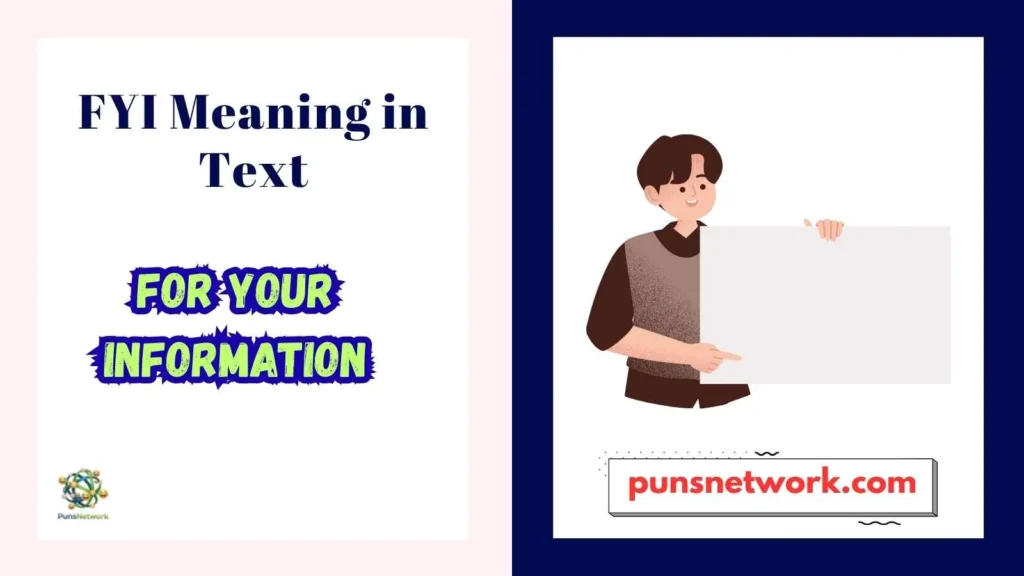
FYI stands for:
“For Your Information”
People use FYI when they want to share information without necessarily expecting a response.
Quick Definition
FYI meaning in text: A phrase used to provide information, updates, facts, reminders, or notifications to someone.
Example
Friend: FYI, the restaurant closes at 9 PM.
Meaning: The sender is simply informing you about the closing time.
In most cases, FYI serves as a helpful heads-up rather than a request for action.
FYI Meaning in Text at a Glance 📋
| Term | Meaning |
|---|---|
| FYI | For Your Information |
| Category | Text Abbreviation |
| Tone | Neutral to Professional |
| Usage | Sharing Information |
| Common Platforms | Texts, Emails, Social Media |
| Response Required? | Usually No |
This simple acronym helps keep conversations concise while delivering useful information.
The Origin of FYI 🕰️
The phrase “For Your Information” existed long before texting and social media.
Historically, it was commonly used in:
- Business correspondence
- Office memos
- Internal communications
- Formal letters
As digital communication evolved, the phrase was shortened to FYI to save time and space.
Evolution Timeline
| Era | Usage |
|---|---|
| Traditional Business Letters | For Your Information |
| Office Memos | FYI |
| Email Era | FYI Widely Adopted |
| Text Messaging Era | Common Acronym |
| Social Media Age | Everyday Usage |
Today, FYI is recognized worldwide and understood across professional and casual conversations.
How FYI Is Used in Text Messages 📱
The fyi meaning in text often depends on the purpose of the message.
Generally, people use it to:
✅ Share updates
✅ Give reminders
✅ Provide useful information
✅ Offer warnings
✅ Clarify situations
✅ Inform without requesting action
Examples
- FYI, I’m running 10 minutes late.
- FYI, your package arrived today.
- FYI, the movie starts at 8 PM.
- FYI, tomorrow is a public holiday.
- FYI, the website is currently down.
In all these examples, the sender is simply passing along information.
FYI Meaning in Different Contexts 🌎
FYI in Casual Conversations
Among friends and family, FYI is often used casually.
Examples
- FYI, I already ordered dinner.
- FYI, Jake won’t be coming tonight.
- FYI, the game has been postponed.
The tone is relaxed and friendly.
FYI in Professional Communication
In workplaces, FYI is extremely common.
Professionals use it when sharing information that may be useful to colleagues.
Examples
- FYI, the client approved the proposal.
- FYI, the meeting room has changed.
- FYI, the report has been uploaded.
This helps keep team members informed without requiring immediate action.
FYI on Social Media
Social media users often use FYI when sharing facts, announcements, or opinions.
Examples
- FYI, the new update is now available.
- FYI, tickets sold out within hours.
- FYI, this feature works on Android and iPhone.
In this setting, FYI acts as a quick attention-grabber.
Why People Use FYI So Frequently 🤝
The popularity of FYI comes from its simplicity.
Benefits of Using FYI
- Saves typing time
- Easy to understand
- Professional yet friendly
- Works in many situations
- Provides context quickly
- Avoids lengthy explanations
Instead of writing:
“For your information, the project deadline has changed.”
Many people simply write:
“FYI, the project deadline has changed.”
The message remains clear while being much shorter.
Examples of FYI in Real-Life Conversations 💬
Understanding examples makes the fyi meaning in text much easier to grasp.
Example 1: Friends
Alex: Are we still meeting tonight?
Sarah: FYI, Emma can’t make it.
Meaning: Sarah is sharing information about Emma.
Example 2: Workplace
Manager: FYI, the presentation has been moved to Friday.
Meaning: The manager is providing an update.
Example 3: School
Student: FYI, the assignment deadline was extended.
Meaning: Helpful information for classmates.
Example 4: Family Chat
Dad: FYI, dinner will be ready at 7 PM.
Meaning: Informing family members about dinner.
Example 5: Online Community
User: FYI, the issue has already been fixed.
Meaning: Sharing useful information with others.
Different Tones of FYI 🎭
Although FYI usually sounds neutral, its tone can vary.
Helpful FYI 😊
- FYI, your phone charger is still here.
- FYI, the sale ends tonight.
This feels friendly and supportive.
Professional FYI 💼
- FYI, the contract has been finalized.
- FYI, the meeting agenda is attached.
This feels formal and informative.
Urgent FYI ⚠️
- FYI, the system outage is affecting all users.
- FYI, the road is currently closed.
This indicates important information that requires attention.
Passive-Aggressive FYI 😬
Sometimes FYI can sound slightly sarcastic.
Example:
- FYI, the instructions were sent yesterday.
Depending on tone and context, this might imply criticism.
This is why communication style matters.
Common Situations Where FYI Is Used 📌
People use FYI in many everyday scenarios.
At Work
- Project updates
- Schedule changes
- Client information
- Team announcements
At School
- Assignment reminders
- Exam schedules
- Class updates
With Friends
- Event details
- Travel plans
- Personal updates
Online
- News sharing
- Product updates
- Community announcements
The flexibility of FYI is one reason it remains popular.
Alternative Ways to Say FYI 🔄
Although FYI is useful, there are many alternatives.
Casual Alternatives
- Just so you know
- Heads up
- By the way
- Thought you’d like to know
- Keep in mind
Professional Alternatives
- Please note
- For reference
- Kindly note
- For awareness
- For your review
Examples
Instead of:
FYI, the meeting starts at 2 PM.
You could say:
- Just so you know, the meeting starts at 2 PM.
- Please note that the meeting starts at 2 PM.
- Heads up, the meeting starts at 2 PM.
Common Mistakes When Using FYI ❌
Many people misuse FYI in certain situations.
Mistake 1: Using It for Requests
Incorrect:
- FYI, send me the report.
This is actually a request.
Better:
- Please send me the report.
Mistake 2: Overusing It
Adding FYI to every message can become repetitive.
Example:
- FYI, good morning.
- FYI, lunch is ready.
- FYI, I’m home.
Use it only when it adds clarity.
Mistake 3: Sounding Rude
Messages like:
- FYI, you missed the deadline.
can sometimes sound harsh.
A softer version would be:
- Just a reminder, the deadline has passed.
FYI Meaning in Text vs Other Popular Acronyms 🔍
Many texting abbreviations look similar but serve different purposes.
| Acronym | Meaning | Purpose |
|---|---|---|
| FYI | For Your Information | Share Information |
| BTW | By The Way | Add Extra Information |
| IMO | In My Opinion | Express Opinion |
| IDK | I Don’t Know | Show Uncertainty |
| BRB | Be Right Back | Temporary Absence |
| ASAP | As Soon As Possible | Urgency |
| TMI | Too Much Information | Oversharing |
Knowing these distinctions helps improve digital communication.
When Should You Use FYI? ✅
Use FYI when:
- Sharing useful information
- Providing updates
- Sending reminders
- Forwarding messages
- Offering context
- Informing others
Good Example
FYI, the event registration closes tomorrow.
Not Ideal Example
FYI, can you call me?
Because this requires action, FYI isn’t the best choice.
How FYI Improves Communication 🚀
The fyi meaning in text goes beyond simply saving characters.
It helps people:
- Communicate efficiently
- Share information clearly
- Reduce misunderstandings
- Keep conversations organized
- Maintain professional communication
In workplaces especially, FYI allows teams to stay informed without creating unnecessary back-and-forth discussions.
This small acronym often improves productivity and clarity.
Is FYI Formal or Informal? 🤔
The answer is both.
Formal Usage
- Business emails
- Reports
- Corporate communication
- Team updates
Informal Usage
- Text messages
- Family chats
- Social media
- Friend conversations
Because FYI works in both settings, it remains one of the most versatile abbreviations in the English language.
Featured Snippet: FYI Meaning in Text 📌
FYI means “For Your Information.” It is a common abbreviation used in text messages, emails, social media, and workplace communication to share information, updates, reminders, or facts without necessarily expecting a response.
FAQs
1. What does FYI mean in text messages?
FYI stands for “For Your Information.” It is used to share information, updates, reminders, or facts with someone.
2. Is FYI rude?
No. FYI is generally polite and neutral. However, depending on wording and context, it can sometimes sound passive-aggressive.
3. Do I need to reply to an FYI message?
Usually not. FYI messages are often informational and do not require a response unless the situation calls for one.
4. Can FYI be used in professional emails?
Yes. FYI is widely accepted in professional communication and is commonly used in emails, reports, and workplace messages.
5. What is another way to say FYI?
Some alternatives include:
- Just so you know
- Heads up
- Please note
- For reference
- Keep in mind
Final Thoughts 🎯
Understanding the fyi meaning in text helps you communicate more effectively in both personal and professional situations. The acronym stands for “For Your Information” and is used to share updates, reminders, facts, and useful details without demanding immediate action. Its simplicity, versatility, and universal recognition make it one of the most widely used abbreviations in modern communication.
Whether you’re texting a friend, posting on social media, or sending an office email, FYI remains a quick and effective way to keep others informed. Mastering its usage can improve clarity, reduce misunderstandings, and make your messages more concise.

Charlie Green is the creative mind behind PunNetwork, a growing online hub dedicated to exploring the fun, evolving world of words, meanings, and internet slang. With a deep passion for language and digital communication, Charlie specializes in breaking down complex terms into simple, relatable explanations that readers of all ages can understand.